What French Sculptor Lived in Rhode Island Shadow Get Produced Equally as Impressive Works of Art
Camille Claudel: The Tumultuous Life and Incredible Work of a French Sculptor
Throughout history, there have been many sculptors who have fabricated a proper name for themselves. One is Auguste Rodin, the famous 19th-century French sculptor who created iconic pieces such equally The Thinker, The Kiss, and The Gates of Hell. Nonetheless, there are possibly simply as many artists who have gone unnoticed—especially women. In fact, it is far less likely that yous've heard of Camille Claudel, a female French sculptor who worked very closely with Rodin for a portion of her career. During their fourth dimension of association, Claudel was Rodin'due south student, banana, muse, and lover. But more than that, she was an incredible sculptor in her own correct—no easy feat for a woman during that period.
Still, despite the raw talent and drive that Claudel possessed, she—like many artists (peculiarly female ones)—did not receive the success and acclaim she so desired and deserved during her lifetime. Though not entirely unknown and unsuccessful every bit an artist, her true importance was overshadowed by that of Rodin. Oftentimes confined by the rigid gender roles women were confined to and ultimately deserted by those she loved near, Claudel lived a tumultuous life that eventually came to a tragic and lone cease.
Though she died in almost complete insignificance, Claudel'southward remarkable talent has since been rediscovered and celebrated to some degree. Read on to discover more almost Camille Claudel's fascinating life and career.
Early Babyhood and Education
The oldest of iii children, Claudel was born to a middle-form family in Fère-en-Tardenois—a minor village in northern France—on December 8, 1864. Her male parent, Louis-Prosper Claudel, later moved the family to Bar-le-Duc In 1870. There, Camille received the beginnings of her education from the Sisters of the Christian Doctrine.
It wasn't until the family unit moved to Nogent-sur-Seine in 1876 that Camille began to experiment with clay and beginning sculpting the human grade. She was only 12 years quondam at the time, simply her talent was already becoming apparent. Her father was receptive to this and sought the opinion of Alfred Boucher, a talented local sculptor. Boucher was immediately impressed by Claudel'southward natural power and took her on as a student and mentee.While Camille'due south father was extremely supportive of her development as an artist, it was a completely dissimilar story with her mother. Louise Anthanaïse Claudel didn't want her girl to pursue a vocation as an artist. Aligned with the societal norms of the time, Louise viewed the profession as "unladylike" and preferred that her daughter give information technology upwards and focus more on her wedlock prospects.
Inflow in Paris and Further Education
In 1881, Louis-Prosper Claudel moved his wife and three children to Paris so that their son—Paul Claudel—could pursue college pedagogy. And so age 17, Camille took this opportunity to go along her artistic grooming and enrolled at the Académie Colarossi—an art academy that was extremely progressive for its time, not only accepting women to written report there merely also assuasive them to work from nude male models.
Boucher continued to mentor the budding sculptor. In 1882, Claudel decided to rent a studio, which she shared with three other young female person sculptors from England that she had met at the Académie. Boucher would visit the studio once a week to offer guidance and critique their work. Camille was already developing a naturalistic style under his tutelage, which earned her some pocket-sized recognition from Paul Dubois—the managing director of the École des Beaux-Arts and beau native of Claudel's previous home, Nogent-sur-Seine—by way of an introduction by Boucher.That same year, Boucher left Paris and moved to Florence, Italia. But before he left, he asked Rodin to take his place and go along to supervise and guide his pupils at the studio. It was there that Claudel and Rodin met, and that meeting marked a singled-out shift that would completely alter the lives of both artists.
Camille Claudel and Auguste Rodin
Rodin was immediately impressed by Claudel's work—though she was but a young student. The gritty realism apparent in her early on works such as Quondam Helen struck him, and he presently invited her to work alongside him every bit an apprentice in his own studio. Claudel officially joined Rodin'southward studio effectually 1883, by which time the seasoned sculptor had already received some of his first major commissions.
Claudel honed her skills in his workshop, learning from Rodin and contributing in equal parts as they worked on some of his most well-known pieces, including The Gates of Hell and The Burghers of Calais. But during her fourth dimension working with Rodin, Claudel also made strides to assert herself as an independent artist. She exhibited regularly in the Salon des Artistes Français between the years of 1882 and 1889, and—past way of some connections made through Rodin—Claudel even had some of her pieces bought by French Museums in the 1890s.Even so, Claudel and Rodin's human relationship was far from only a professional one. The two had mutual respect and admiration for one another and had become engaged in an impassioned love affair not long after they met. Fifty-fifty more than than his apprentice, she became his confidant, model, and muse. Rodin created several portraits of Claudel during this period—starting with Camille Claudel with Brusque Hair—and also used her as a model for portions of his larger works. He, in turn, was also a model for Claudel on occasion, most notably for her acclaimed work Bust of Rodin. The two artists' creations mutually inspired and influenced ane some other every bit they worked together seamlessly, sharing both models and studios.
Break From Rodin
Claudel and Rodin's relationship continued for over ten years, but things were not always then proficient. In fact, their romance had sparked a corking deal of controversy—one reason being their sizable historic period gap, with Claudel not all the same twenty when they first met and Rodin already into his 40s. Ane other reason was his relationship with Rose Beuret, who—though they were never officially married—had been his partner for years.
This second bespeak was peculiarly hard for Claudel, whose intense feelings for Rodin had grown sizably over the years, making it harder and harder for her to have his relationship with Beuret. She had fifty-fifty gone then far on 1 occasion as to brand him sign a contract promising to be faithful to her. Though Rodin had become so important in her life during their many years together, Claudel began to realize that he would never exit Beuret. This, and her ever-growing desire to emerge from Rodin's sweeping shadow, spurred her to altitude herself further and farther from the creative person—both personally and professionally—starting effectually 1892.Though she had established and proved herself as an individual artist, people would always compare her to Rodin and attribute her talent and technique to the tutelage of the celebrated sculptor. Looking for a style to distinguish herself further from her old partner and assert her own creativity and genius, Claudel took a new direction with her work. She began to explore more than intimate scenes, with more daring compositions, new subjects, and more difficult materials. Some of her most evocative and sensational piece of work is from this period, including pieces such as The Flit, The Moving ridge, and Sakuntala.
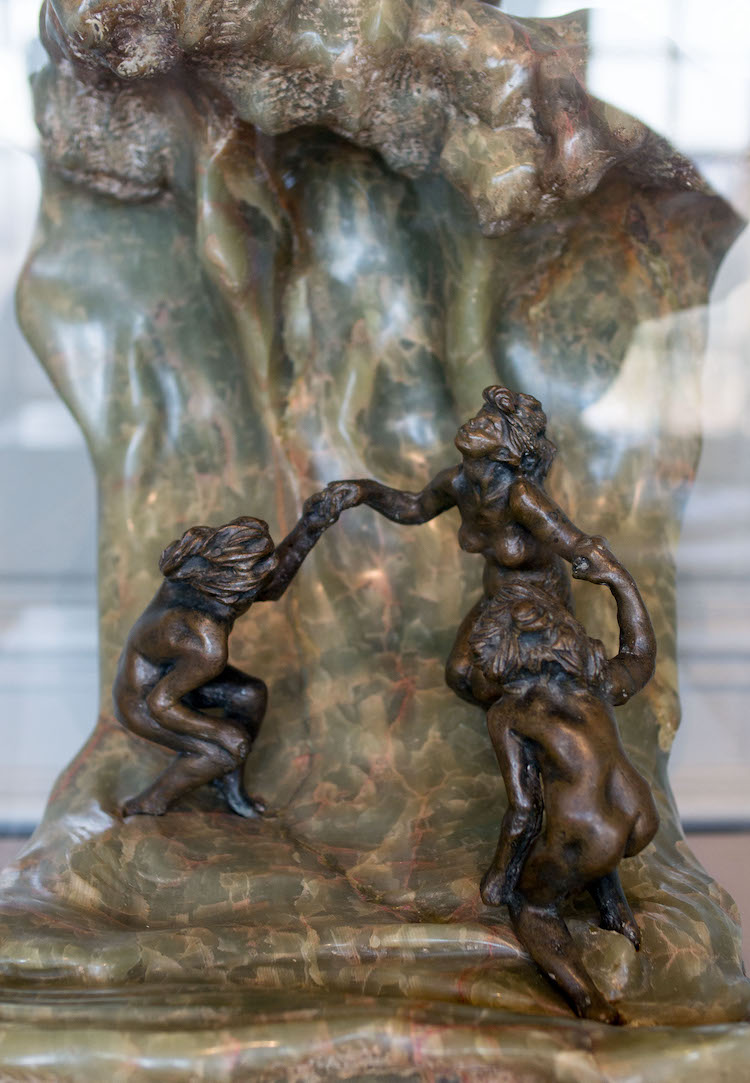
The Wave (Photograph: Thibsweb [Public domain])
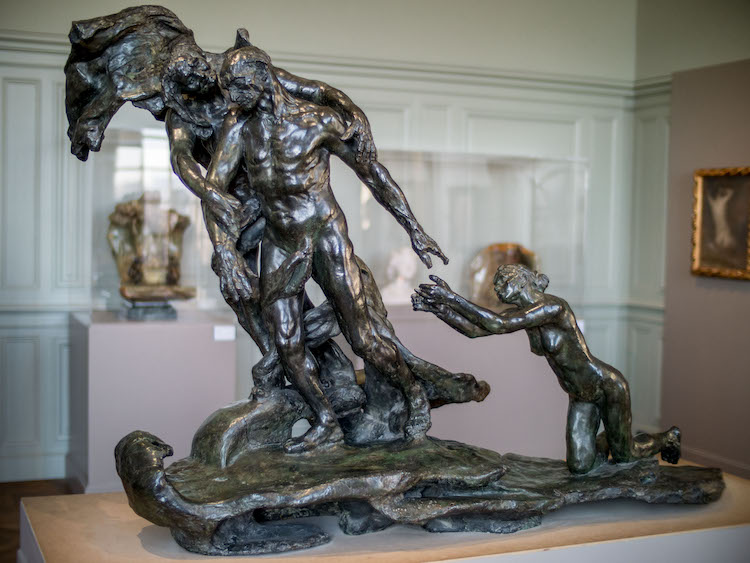
The Age of Maturity (Photo: Thibsweb [Public domain])
She had created this sculpture for her first commission from the French state in 1895, originally with the support and endorsement of Rodin. Yet, when he saw the sculpture for the starting time fourth dimension, he was shocked, angry, and offended. He subsequently retracted his public support for Claudel'south work and severed all ties with his quondam lover. Her committee was besides later revoked with little explanation, though many speculate that Rodin may have pushed the state to end its clan with Claudel.
Tragic Final Years
After this final pause with Rodin, things apace began to decline for Claudel. Though she had wanted to distance herself from the creative person, his public support and endorsement of her work had protected her to some degree from many of the sexist practices evident in their creative vocation. She increasingly lost support because of the overtly sensual nature of several of her pieces, which was not deemed acceptable for a female artist.
Every bit her career speedily declined and she brutal into fiscal ruin, Claudel became increasingly paranoid and convinced that Rodin was plotting confronting her to ruin her and steal her ideas. Because of this, she became more and more than reclusive, destroying a large portion of her pieces to prevent Rodin from copying them and even refusing to sculpt annihilation new. By 1911, she had become a shut-in, her physical and mental health continually worsening.
In March of 1913, her father—who had always supported and championed her—died, and no one from her family unit informed her. Claudel's human relationship with her female parent, which had always been fraught from the moment the young girl decided to exist an creative person, had just deteriorated further and further over the years as her indecorous relationship with Rodin and the "unladylike" nature of her piece of work only deepened the rift between Claudel and her mother.
There isn't much information nigh Claudel's relationship with her ii siblings over the grade of her career, though she had completed several busts of her blood brother throughout the years and at least ane of her sis on the occasion of her marriage. Nevertheless, only a few days later on the death of her father, Claudel'south remaining family had her committed at the Ville-Evrard mental asylum.She was subsequently transferred to Montdevergues asylum in 1914—due to the outbreak of WWI—and remained there until her decease on October 19, 1943. Over the course of her 30-year confinement, she received very few visits from her family unit or friends. Claudel spent the balance of her days in isolation, removed from all the things that had once made her life vibrant.
"I have fallen into an abyss," the artist wrote to i of her few remaining contacts during her fourth dimension at Montdevergues. "I alive in a world so curious, so strange. Of the dream that was my life, this is the nightmare." Subsequently Claudel's lonely decease, her body was buried in an unmarked communal grave on the aviary grounds.
Camille Claudel'south Legacy
In spite of the unjust decline of her sculpting career every bit well every bit her life'due south tragic ending, the earth has once again started to take find of the piece of work of Claudel. Then compelling is her story that information technology has fifty-fifty been the inspiration for books, plays, films, and fifty-fifty a musical. Before his own decease in 1914, Rodin canonical plans to add a Camille Claudel room to his museum. These plans were completed in 1952 when Claudel's brother, Paul, donated several of his sister'south works to the Musée Rodin.
Furthermore, Claudel finally received the stardom and recognition for her ain artistic merit that she so desired and deserved during her lifetime when the Musée Camille Claudel was opened in 2017. The museum is made up in function of the artist's childhood domicile and features around 40 of her surviving works. Thanks to this, her incredible talent and contributions to modern sculpture are now being recognized and celebrated in a fashion that they never could have been during her lifetime.Related Articles:
The Life and Work of Barbara Hepworth, a Modern Main of Abstract Sculpture
x Great Sculptors Who Changed the History of Art
How a Single Sculpture Inspired Some of Rodin'southward Most Famous Works
5 Must-See Museums in Paris (That Aren't The Louvre or Musée d'Orsay)
Source: https://mymodernmet.com/camille-claudel/
0 Response to "What French Sculptor Lived in Rhode Island Shadow Get Produced Equally as Impressive Works of Art"
Postar um comentário